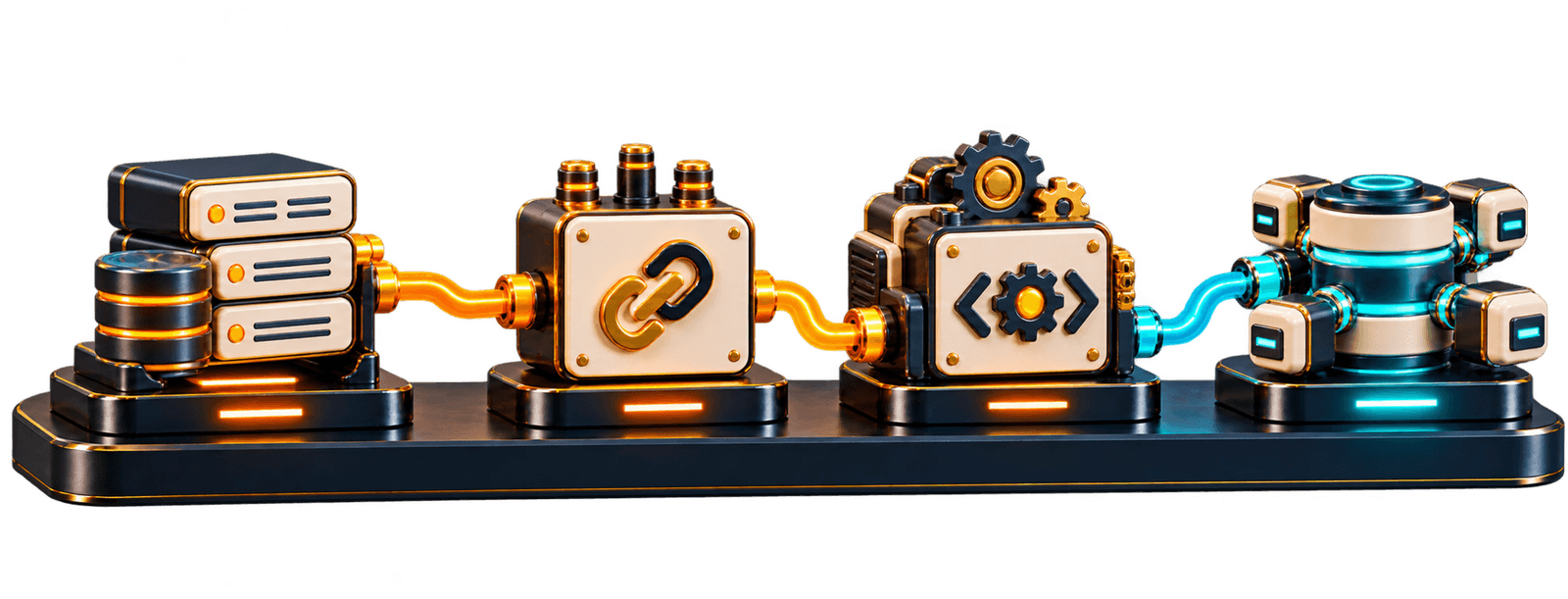
Technology that understands how a business actually runs.
XPANCA grew out of the need to digitalise operations inside the GDN business ecosystem. That is why every solution starts from your processes, your bottlenecks and your goals—not from the technology.
Your business keeps moving. Systems that fall behind start holding it back.
As transactions, data, people and processes grow, small frictions pile up—slowing down coordination and decisions.
01
Repeated
The same work, done over and over
Re-entering data and reconciling it by hand keeps eating into your team’s time.
Impact: Time wasted
02
Scattered
Data spread across too many places
Spreadsheets, chats and separate apps produce figures that do not always agree.
Impact: Data out of sync
03
Delayed
You see the state of the business too late
Reports have to be pulled together before management can see what is actually happening.
Impact: Decisions on hold
04
Forced
The team bends to fit the tools
Processes follow the limits of the software, not what the business really needs.
Impact: Processes grow fragile
The problem does not stop at efficiency. It starts to affect decisions, service, and the business’s ability to grow.
The XPANCA approach
Not everything needs replacing. Start with what holds you back most.
XPANCA helps you find the point that weighs most on your operations, choose the solution that fits, and connect it step by step as the business is ready to grow.
01
Keep what still works
Systems and processes that are still relevant do not need replacing just for the sake of new technology.
02
Fix what holds you back most
Prioritise the problems that most affect time, data, service or decision-making.
03
Connect when the business is ready
Solutions can start separately, then grow into a connected system and a single source of data.
Start realistically. Grow without starting over.
XPANCA solutions
Solutions that fit your world.
Choose your context. See how a single need can grow into a connected system.
01 / 03
Retail Business
Start simple. Run things in better order.
For businesses that want to tidy up sales, orders, customers, stock, finance and operations without a complicated system.
For schools and educational institutions that want to connect administration, academics, student identity, parent communication, and payment services through licensed partners.
Administration and academics
Student identity and attendance
Parent communication
Payment integration through banks or licensed PSPs
XPANCA began with GDN’s own operational need to unify its systems, fill in missing functions, and depend less on many different vendors.
PT Gerbang Digital Nusantara
From many tools to one system that works together.
01· Starting Point
As GDN grew, its lines of business became more varied. Each need was met with a different tool.
02· Obstacles
Tools from different vendors were hard to modify and integrate. Functional gaps remained, while subscription and management costs kept growing.
03· Approach
XPANCA mapped GDN’s processes, needs and operating culture to design a system foundation that is relevant and complete.
04· Progress
Old tools were replaced step by step, unmet needs were built, and everything was connected in one system. Managing the systems became simpler and is no longer spread across many vendors.
We have gathered the things organisations usually want to be sure of before they start working with XPANCA.
?
Not finding the answer you need? Tell us about the process you are dealing with—we will help map out where to start.
We start by understanding your goals, your users, the processes already running and the obstacles that matter most. From there, XPANCA recommends the form of solution that makes the most sense—ready-made, tailored, or custom-built.
Discovery
Design
Build & Test
Launch & Support
Not always. XPANCA can use solutions that already exist, adapt a foundation you have, integrate the tools that are still relevant, or build a custom system when a process really is unique.
The choice follows your needs, complexity, timeline, budget and readiness—not a package pushed onto you.
Yes. Implementation can start with the most pressing need. Its data structure and processes are still designed so other modules can be added or connected when the organisation is ready.
The aim is to deliver value sooner without forcing you to replace every system at once.
In many cases, yes. It depends on the API access, documentation, permissions and data structure of those tools.
Whether an integration is feasible is checked during discovery, before the scope, the data-exchange method and the development estimate are decided.
It depends on the scope, the degree of customisation, integration needs, data migration and how ready your users are. Ready-made solutions can usually go live sooner, while custom or multi-unit systems are delivered in stages.
After discovery, XPANCA sets out the phases, a time estimate and launch priorities you can measure against.
Cost depends on the scope of the problem, the number of users or units, the modules needed, the degree of customisation, integration, data migration and support needs.
A proposal follows once your needs are well enough understood. If the scope is large, implementation can be split into phases so investment follows your priorities.
Yes. Depending on the service scope you choose, support can cover user training, a stabilisation period, maintenance, issue monitoring, usage reviews and further development based on real needs.
The details of coverage, response times and support period should be set out transparently in the proposal or contract.
Start a conversation
Start with the problem you most want to solve.
Tell us about the process that still slows your organisation down. XPANCA will help map out the most sensible first step—without building a large system straight away.
The first conversation is about your needs, not about selling a package.